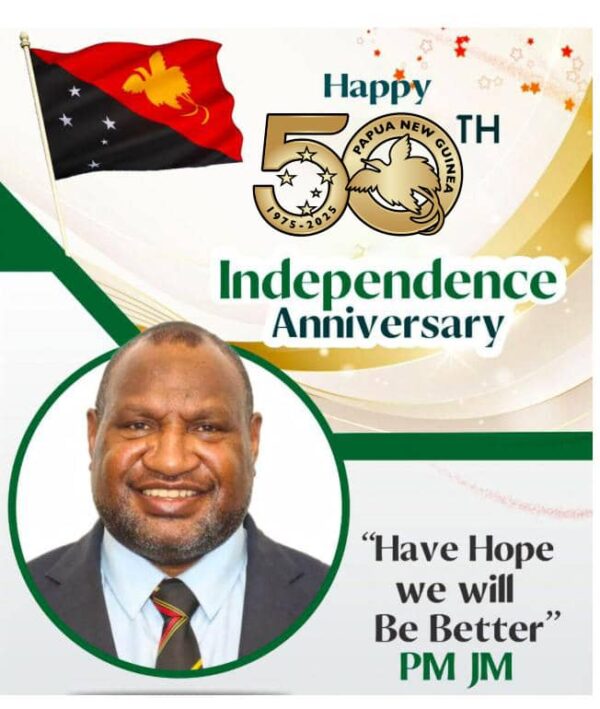
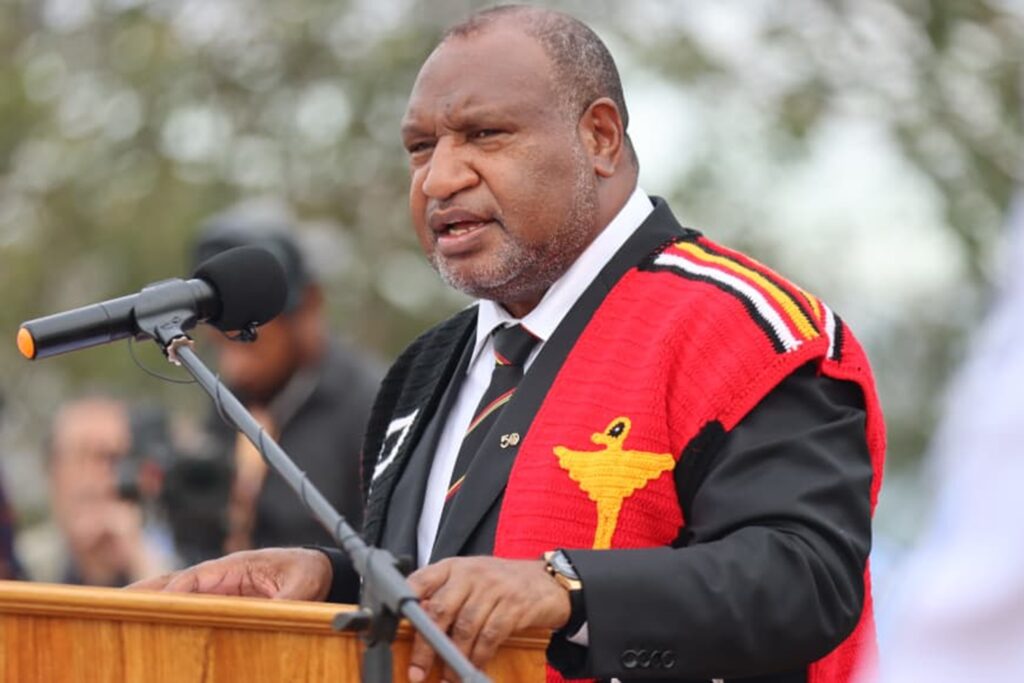
Port Moresby, Tuesday, 16 September 2025 — Fifty years after Papua New Guinea’s national flag first rose on Independence Hill, thousands of citizens, leaders, and international partners gathered at the same sacred ground this morning to commemorate the nation’s Golden Jubilee. At the heart of the ceremony was a powerful call from Prime Minister Hon. James Marape, who urged Papua New Guineans to embrace unity, honesty, and a renewed commitment to service as the nation steps into its next fifty years.
A Ceremony Steeped in Symbolism
The event carried deep historical resonance. Independence Hill was once again the stage where the nation’s red, black, and gold flag — adorned with the bird of paradise and Southern Cross — was hoisted to the sound of the national anthem.
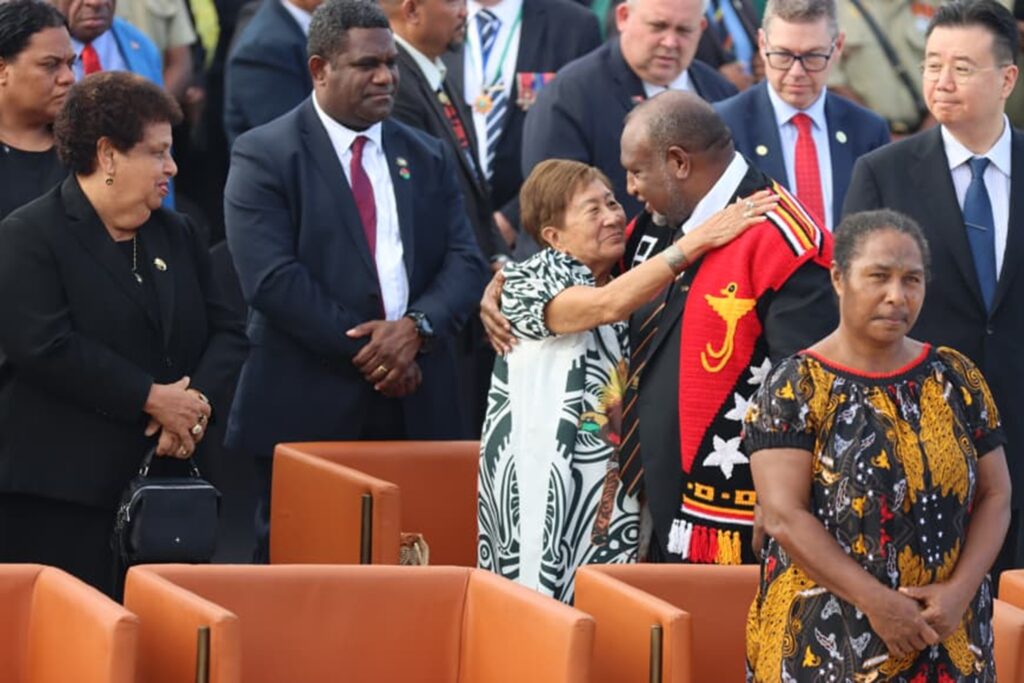
Joining the celebrations were His Royal Highness the Duke of Edinburgh, Pacific leaders, ambassadors, church dignitaries, and representatives of development partners. Members of the founding generation and families of past prime ministers were also present, visibly moved as the flag returned to the skies where they had first seen it raised in 1975.
For Prime Minister Marape, this moment was more than commemoration. It was, as he put it, “a time to reset our minds, our purposes, and our zeal” for the next era of national progress.
Honouring the Somare Generation
Prime Minister Marape opened his speech with tributes to the “Somare generation” led by Grand Chief Sir Michael Somare, who, with his colleagues, navigated PNG into independence. He recognised Dr John Momis, John Kaputin, Lady Veronica Somare, Lady Stella Chan, and families of other leaders who shaped the nation’s founding.
“They were the greatest generation Papua New Guinea ever produced,” the Prime Minister said. “They dared to believe that a thousand tribes, speaking over 800 languages, could unite as one people, one nation, one country. Their achievement will never be repeated.”
In reflecting on history, Prime Minister Marape stressed that PNG’s identity reaches back thousands of years. He pointed to the UNESCO-listed Kuk Early Agricultural Site, evidence of farming dating back 10,000 years, and the Lapita pottery found in New Ireland, linking PNG to wider Pacific seafaring traditions. “We are an ancient people,” he said. “Long before roads, planes, or medicines, we traded, coexisted, and thrived.”
Recognising Partners, Churches, and Ordinary Citizens
The Prime Minister also acknowledged the role of missionaries, churches, and educators who laid the foundation for modern PNG. “Papua New Guinea can claim its place as the last country on Earth to have received the Gospel of Jesus Christ. Since then, the church has been our moral anchor, shaping our education, health, and leadership systems,” he said.
He extended gratitude to Australia, describing the transition to independence as one rooted in respect and goodwill. He quoted Sir John Guise’s words of 1975: “We are lowering the Australian flag, not tearing it.”
Importantly, Prime Minister Marape saluted the “unsung heroes” of nationhood — public servants, teachers, health workers, police officers, defence personnel, and farmers. “You have served your flag well. You have honoured your Constitution. The last fifty years belong to you as much as to our leaders.”
Achievements and Struggles
The Prime Minister described PNG’s story since 1975 as a journey of resilience. Despite political instability in the first three decades, PNG preserved democracy while other nations faltered. Over time, infrastructure was built, schools expanded, and citizens began to excel internationally.
He cited examples of national progress, such as PNG pilots commanding international aircraft, doctors conducting kidney transplants at home, and engineers contributing to global industries. “Fifty years ago, we could not have imagined our daughters flying Airbus aircraft across the Pacific,” he said.
But he was equally candid about ongoing struggles. “We still have poverty, isolation, unemployment, and corruption robbing us of resources. Our economy has yet to fully sustain a nation of over 10 million people,” he admitted. “Yet history shows Papua New Guineans never give up.”
Bougainville: A Story of Reconciliation
A poignant part of the speech was dedicated to Bougainville. Prime Minister Marape expressed regret for the pain of the Bougainville conflict but praised the island’s people for choosing peace through dialogue and reconciliation.
“In 1975 we were one, and today we are still one,” he said. “Bougainville’s story is also Papua New Guinea’s story — a story of resilience, reconciliation, and hope. The peace we share today was won not by war, but by the courage of people to embrace peace.”
The presence of over 100 Bougainville children for celebrations in Port Moresby underscored this message of unity.
A Vision for the Next 50 Years
Looking to the future, Prime Minister Marape unveiled a bold national agenda, positioning agriculture, infrastructure, energy, and governance reform as the pillars of progress.
• Agriculture: One million families will be transitioned from subsistence farming to commercial agriculture.
• Infrastructure: Roads, bridges, ports, and ICT will link all regions, including long-isolated districts.
• Clean Energy: Investment in hydro, solar, and renewable energy will expand access and create jobs.
Economic Targets: PNG’s economy will grow to K200 billion by 2030, K300 billion by 2035, and K500 billion by 2045.
• Governance Reform: Public service efficiency will be modernised with artificial intelligence and ICT to stamp out nepotism and corruption, moving toward a merit-based society.
• Judiciary: Judicial independence will be preserved and court systems modernised to uphold justice.
• Democracy: Above all, democracy will be protected as the cornerstone of PNG’s unity.
“The next 50 years must be about nation building, renewal, and transformation,” he declared. “Let us preserve our democracy at all costs, for it is democracy that has carried us this far.”
A Personal Journey from the “Least of the Least”
In one of the most emotional moments of the ceremony, Prime Minister Marape recalled his childhood in Nomad River, Western Province, where he first saw the PNG flag raised as a barefoot boy who could not speak English.
“Fifty years later, that same boy stands here as your Prime Minister,” he said. “This is the story of Papua New Guinea. If a child from the remotest of the remote can rise to this office, then every boy and girl in this country has the same potential.”
Appealing directly to older citizens, especially those born in the 1960s and 1970s, he said, paraphrasing John F. Kennedy: “Do not ask what others are doing for the country. Ask yourself: what are you doing for Papua New Guinea?”
A Call to Action
Closing his address, Prime Minister Marape said the raising of the flag must be matched by a lifting of the nation’s spirit.
“Our diversity is not our weakness but our greatest strength. The bird of paradise on our flag soars today — let our spirits soar with it. The next 50 years belong to our children. Let us serve them by building a nation that is united, prosperous, and just.”
As the crowd sang the national anthem and the flag unfurled against the Port Moresby sky, the Prime Minister’s words captured the essence of a nation proud of its past, aware of its struggles, and committed to shaping a brighter future together.
ENDS
